Is AI Replacing Ghostwriting? What Writers Need To Know
There’s a new headline every few months claiming AI’s about to wipe out some creative job, and lately it’s ghostwriting’s turn in the spotlight. Fair enough, on the surface. A tool that spits out a chapter in under a minute does sound like bad news if you’re the one usually charging for that chapter. But sit in on an actual working ghostwriter’s day, the interviews, the memoir sessions, the back and forth drafting a CEO’s keynote, and the whole picture gets messier than any headline lets on. So let’s actually dig through this properly and answer the real question everyone’s typing into Google: is AI replacing ghostwriting, or is it just changing how the job gets done?
Is AI Replacing Ghostwriting?
No. Not really, and definitely not the way most headlines want you to believe. Is AI replacing ghostwriting outright? Not even close, honestly. What’s happening is more of a shift in how the job gets done, not some wholesale swap of human for machine. AI’s great at speeding up brainstorming, rough drafts, and digging through research. What it’s not doing is sitting across from a widow for two hours while she talks through her husband’s last year for a memoir she’s finally ready to write. It doesn’t know why one specific phrase matters so much to how a CEO wants to come across either. That part’s still entirely human.
Understanding AI Ghostwriting
AI ghostwriting, at its core, just means leaning on AI tools to generate content that ends up published under someone else’s name. Same basic idea as regular ghostwriting, just with a language model doing part of the drafting instead of a person typing every line by hand from scratch.
These tools work off predicting likely word sequences, based on patterns learned from a genuinely massive pile of existing text. Which, put plainly, means they’re really good at sounding plausible, fast. ChatGPT, Claude, Gemini, Microsoft Copilot, all of these have become the default starting point for a lot of writers now, mostly for outlines or a rough first pass, something to push against instead of staring at nothing.
Will AI Replace Ghostwriting Entirely?
This is usually the follow up question once people understand what AI ghostwriting actually is, will AI replace ghostwriting entirely, or just certain parts of it? Based on what these tools can and can’t do right now, entirely replacing it looks unlikely anytime soon.
What Does a Professional Ghostwriter Actually Do?
Here’s the thing the “AI’s replacing ghostwriting” panic keeps skipping past. Most of a ghostwriter’s job doesn’t even happen at a keyboard. It happens before and around it.
- Digging into someone’s background, their industry, whatever’s already out there about them
- Actual interviews, sometimes dozens of hours spread over months
- Taking rambling, half formed conversation and shaping it into something with an actual arc
- Nailing down a specific person’s voice, the rhythm, the odd little phrases only they use
- Steering the whole thing through publishing, which is its own maze
- Editing. Over and over, until it finally sounds right
If you’ve ever wondered how do you hire a ghostwriter and what you’re actually paying for, well, this is it. Not typing speed. You’re paying someone to take your scattered memories and turn them into something that reads clean and still sounds like you, not like a stranger describing your life. None of this fully answers is AI replacing ghostwriting on its own, but it does explain why the human side of the job stays so hard to automate.
AI Writing VS Professional Ghostwriting
| Factor | AI Writing | Professional Ghostwriting |
|---|---|---|
| Creativity | Pattern based, derivative | Original, shaped by lived experience |
| Accuracy | Prone to confident errors | Fact checked against real sources |
| Research | Surface level, limited depth | Deep, often interview based |
| Confidentiality | Data handling varies by tool | Strict, contractually protected |
| Human empathy | None | Central to memoir and personal work |
| Strategic thinking | Limited to prompted instructions | Anticipates audience and goals |
| Cost | Cheap or free | Ranges based on project scope |
| Speed | Near instant | Weeks to months |
| Editing | Requires heavy human revision | Built into the process |
| Publishing readiness | Rarely ready as is | Polished for submission or release |
Why Everyone Is Asking “Is AI Replacing Ghostwriting?”
Not exactly a mystery why this question’s suddenly everywhere. ChatGPT, Claude, Gemini, Copilot, these went from something people had barely heard of to a daily habit for millions, in what’s honestly a pretty short stretch of time. AI writing adoption’s climbed fast in just about every industry that touches words at all. Ghostwriting’s entirely about words. So no, it was never going to sit outside this conversation for long.
Will AI Replace Ghostwriting the Way It Replaced Other Jobs?
That comparison comes up a lot, but ghostwriting has always depended on trust and personal access that most automated jobs never required, which is why fears that AI will replace ghostwriting the same way it replaced, say, basic transcription work don’t really hold up.
How AI Changed the Content Industry
Marketing teams now bang out rough email campaign drafts in minutes instead of burning half an afternoon on them. Journalists lean on AI to chew through dense reports before writing up their actual angle. Publishing houses are poking at AI carefully for early editing passes, nothing too committed yet. Business writing, memos, reports, all of it’s picked up speed too.
Content marketing specifically has soaked this stuff up faster than nearly any other writing field. It’s part of why so many people outside ghostwriting specifically are also asking is AI replacing writers in general, across journalism, marketing, and publishing all at once.
Industries Most Affected
Publishing, journalism, PR, marketing agencies, business consulting, these have all felt it more than most. Makes sense, these were already industries cranking out huge amounts of written content on tight deadlines, so AI slotted right into workflows that were already stretched thin. Ghostwriting sits right next to several of these fields, which is a big reason this question keeps looping back around.
Can AI Really Replace Professional Ghostwriters?
This is usually where the is AI replacing ghostwriting debate gets the most heated, since AI’s strengths here are genuinely impressive.
What AI Does Exceptionally Well?
Give credit where it’s due. AI’s genuinely strong at a handful of specific things. Throwing out a bunch of angles for a chapter you’re stuck on. Spitting out a rough outline worth arguing with. Producing a quick, messy first draft paragraph, something to react to instead of a blank page. Summarizing long, dense research fast. Helping dig up information a writer might’ve otherwise burned hours hunting down by hand.
Can AI Replace Ghostwriters for Simple Projects?
Can AI replace ghostwriters entirely for something short and low stakes, like a basic bio or a simple blog post? Maybe, for the most basic projects. For anything involving real nuance, not really.
Is AI Good for Ghostwriting Tasks Like Research and Outlines?
Is AI good for ghostwriting when it comes to mechanical, early stage work? Genuinely, yes. For the deeper creative and relational parts of the job, less so.
Where AI Still Falls Short
Then there’s basically everything else it just can’t touch. Emotional intelligence, the kind you need sitting with someone recounting something genuinely painful, knowing when to push a little further and when to just shut up and let them talk. Actually running an interview, reading tone, following some random thread a subject brings up that wasn’t in your notes at all.
Original storytelling drawn from someone’s real, lived experience, not patterns lifted from a pile of existing text somewhere. Critical thinking about which parts of a messy, sprawling life actually belong in the narrative and which parts need cutting. Fact verification, the kind that means picking up a phone and calling a real person, not just trusting whatever a tool confidently generated.
Human Skills AI Cannot Replicate
Empathy, for one. Strategic communication built around a specific audience and what they actually need to hear. Brand storytelling that captures something genuinely hard to pin down about who a person or company really is. Relationship building over the course of a project that might drag on for a year. Real subject expertise, built from actually doing the work for years, not from having read a lot about it.
How AI Is Transforming Ghostwriting Instead Of Replacing It?
How AI is changing ghostwriting shows up most clearly in the small stuff: faster outlines, quicker research, less time spent on formatting, not in the actual heart of the work.
AI as a Writing Assistant
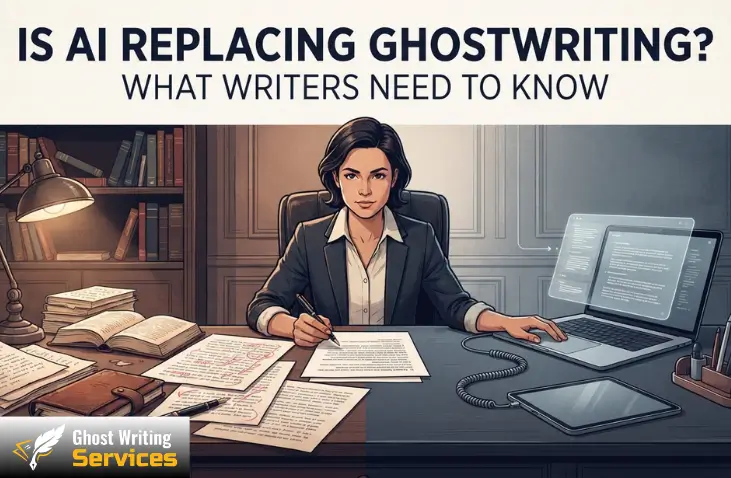
This is where the real shift’s quietly happening. AI can replace ghostwriting for a narrow slice of tasks, brainstorming, rough first drafts, quick research summaries, but not the whole gig. Most ghostwriters working right now use these tools kind of like a carpenter uses a power drill over a hand screwdriver. Faster on the grunt work. Still totally dependent on the person holding it to decide where anything actually goes.
Is AI Replacing Ghostwriters Or Just Assisting Them?
Is AI replacing ghostwriters outright, or simply taking over the repetitive parts of the job? Based on everything ghostwriters actually do day to day, it’s clearly the second one.
Human Editing Still Matters
AI drafts still need real editing, and honestly this part doesn’t get talked about enough whenever people argue over whether AI will replace ghostwriters. Tone’s have to be checked against how a specific person genuinely talks, not some generic approximation. Flow needs fixing so a chapter doesn’t read like a bunch of paragraphs stapled together.
Structure needs a human eye that can catch when a story’s dragging in one spot and rushing through another. Storytelling elements need someone with an actual feel for pacing. And credibility, especially on memoir and nonfiction work, comes down entirely to a human confirming what’s on the page actually happened the way it’s written.
Hybrid Writing Workflows
Realistically, the future here isn’t AI against humans; it’s AI and human, working alongside each other, tool handling speed, and person handling judgment. A ghostwriter might draft a rough outline with AI, then rewrite most of it by hand once real interview material starts rolling in. This kind of hybrid setup’s fast becoming just… normal, not some novelty.
The Future Of Ghostwriting In An AI-Driven World
Is ghostwriting still relevant now that AI tools are everywhere? Based on demand for memoirs, executive communications, and books that need a real human voice, yes, very much so.
Emerging AI Trends
The future of AI writing keeps trending toward tools that are faster and more personalized, but faster isn’t the same thing as replacing human judgment. Worth keeping an eye on a few things. AI agents that can handle multi-step tasks without needing constant hand holding. Personalized AI trained on a specific writer’s own past work and voice. Multimodal AI working across text, audio, and video at once. Voice AI that transcribes and analyzes spoken interviews with steadily improving accuracy, genuinely handy for ghostwriters wading through hours of raw interview footage.
Will AI Replace Ghost Writers as These Tools Improve?
Even as tools get sharper, will AI replace ghostwriters who specialize in things like memoir or executive speechwriting? Unlikely, given how much of that work depends on trust built over months, not just better software.
Future Skills Ghostwriters Need
The future of AI writing means the skill set here is shifting, not vanishing. AI prompting’s turning into an actual professional skill now, knowing how to pull something useful out of these tools instead of generic mush. Research matters more, if anything, since checking AI generated claims takes real effort. Fact checking’s become a bigger chunk of the job overall, given how often attempts at using AI can replace ghostwriting end up producing confidently stated nonsense nobody caught in time. Editorial strategy, deciding what stays and what gets cut, is still squarely human work.
For anyone newer to the field wondering how can I start ghostwriting with no experience, the honest path usually runs through smaller paid projects first, building a portfolio before chasing bigger clients.
Does AI Threaten Ghostwriters’ Job Security?
Does AI threaten ghostwriters the way some fear, or does it mostly threaten the writers who refuse to adapt at all? Most working ghostwriters say it’s clearly the second one.
New Career Opportunities
This shift actually opened up new roles too, not just quietly killed old ones. AI editor positions, focused purely on cleaning up AI generated drafts. Content strategists figuring out how AI and human writing actually fit together across a bigger project. Prompt specialists who’ve genuinely gotten good at pulling quality output out of these tools instead of garbage. Brand storytellers who focus entirely on the voice and narrative work AI still can’t reach.
Ghostwriting Across Different Formats
Worth remembering that “ghostwriting” isn’t one single job either, which is part of why AI struggles to generalize across it. Memoir ghostwriter services lean heavily on emotional interviews and trust built over months. Speech ghostwriting services demand a completely different skill, capturing how someone actually sounds out loud rather than on a page.
Other formats stretch even further from anything AI handles well. Some clients hire fiction ghostwriters for full length novels, while others need poem ghostwriting or professional rhyme ghostwriting for something more lyrical. A eulogy ghostwriter handles grief and tribute with a level of sensitivity that’s hard to fake. There’s also steady work for a story ghostwriter for hire, a bio ghostwriter for shorter personal pieces, and even clients who want to hire a ghost songwriter for lyrics rather than prose.
Common Myths About AI Replacing Ghostwriting
There’s a persistent myth floating around that AI can replace ghostwriting across the board, no exceptions, which isn’t really borne out once you look at what actually happens on real projects.
Myth vs Reality
- Myth: AI writes books better than people do.
- Reality: it can churn out competent sounding prose, sure, but real narrative depth on its own? Rare.
- Myth: AI replaces writers, period.
- Reality: is AI replacing writers across the board? No. It’s replacing specific tasks inside the job, not the whole profession.
- Myth: AI generated content doesn’t need editing.
- Reality: it almost always does, often a lot of it.
- Myth: AI comes up with genuinely original ideas.
- Reality: it’s remixing existing patterns, not generating anything actually new.
- Myth: AI understands human emotion.
- Reality: it can fake the language convincingly enough, but it doesn’t feel or understand a single thing.
The honest answer to whether AI replaces ghostwriters keeps coming back the same way no matter how the question’s phrased, not entirely, not anytime soon.
Key Takeaways
- Is AI replacing ghostwriting? No, not based on the actual day to day evidence from working writers.
- AI boosts productivity, mostly on the mechanical side of the job.
- Human creativity, empathy, and judgment are still the actual value a ghostwriter brings.
- Hybrid workflows, AI plus human editing, are quickly becoming just how this works now.
- Is AI replacing ghostwriters? The data and the day-to-day reality both say no, not entirely.
- Can AI replace ghostwriters for the deep, personal work of a memoir? Not based on what these tools can currently do.
- Professional ghostwriters still play a genuinely vital role in books, executive communications, and thought leadership that depends on real human insight.
Where This Leaves the Industry
Anyone weighing whether to bring in help for a book, memoir, or any big writing project, it’s worth actually knowing what’s out there. Plenty of range exists, from top ghostwriting companies handling big multi book deals, down to solo writers working out of a spare room. Most roundups of the best ghostwriting services tend to rank companies by portfolio strength and client reviews rather than price alone, worth checking a few before committing to one.
How Ghostwriting Services Work?
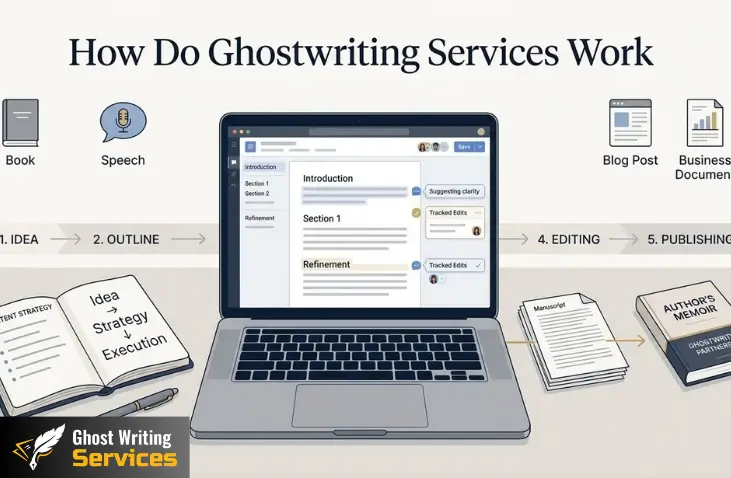
Curious how ghostwriting services work behind the scenes? Usually starts with a consultation, moves into research and interviews, then wraps through several rounds of drafts and revisions, a process AI genuinely speeds up here and there, sure, but hasn’t come close to replacing outright. Browsing a list of ghostwriting services is often the fastest way to see how differently each one structures that process. All of this matters most in the context of the original question, is AI replacing ghostwriting or simply reshaping which parts of the job people pay for.
Is Ghostwriting a Real Career Path?
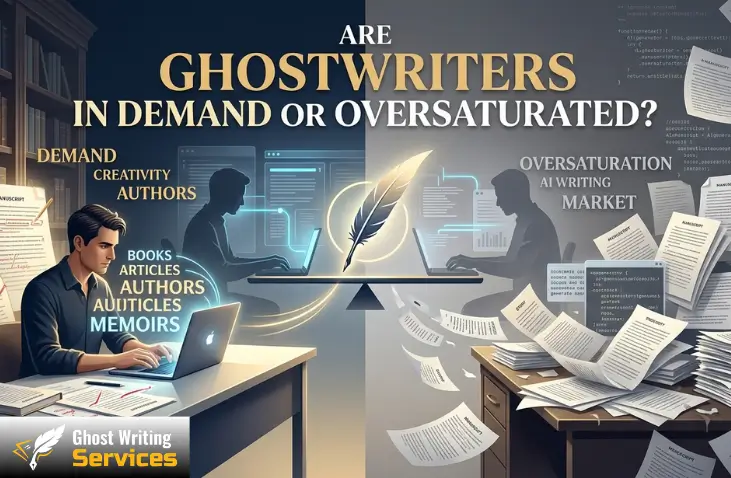
And if you’re wondering whether this is even still a real career path with all this noise swirling around, are ghostwriters in high demand? Genuinely, yes, especially for executives, public figures, authors who need someone who can actually nail their real voice, not just churn out plausible sounding sentences.
One more thing worth addressing head on, since it comes up constantly. Should ghost writing be credited as author? Traditionally, no, that’s kind of the whole point of the arrangement. Though some clients these days do choose to credit a writer as “with” or “as told to,” a trend that’s grown right alongside more collaborative, AI assisted workflows becoming the norm.
Conclusion
So, is AI replacing ghostwriting? After all that, the answer holds steady, no, but it’s absolutely reshaping how the actual work gets done. Is AI replacing writers across creative fields broadly? Not based on what’s actually happening in ghostwriting specifically. The writers who come out ahead over the next few years won’t be the ones refusing to touch AI out of stubbornness, and they won’t be the ones handing whole projects off to a chatbot either.
They’ll be the ones who’ve figured out exactly where AI genuinely helps, brainstorming, rough drafts, research summaries, and exactly where it can’t go, real interviews, emotional nuance, a client’s actual voice landing on the page. That balance, not a full swing toward either side, is really where this whole thing’s headed.