What Is The 90/10 Rule For Authors? Complete Guide
Several writers and authors may have experienced this phase where they are working hard, day and night, yet still their progress bar is moving slowly. It becomes frustrating when you seem to be giving your all yet seeing very few results. It becomes sort of demotivating where one starts believing that no matter what they do, it won’t work. However, the truth is that several authors are just unaware of the 90/10 rule.
What Is The 90/10 Rule For Authors?
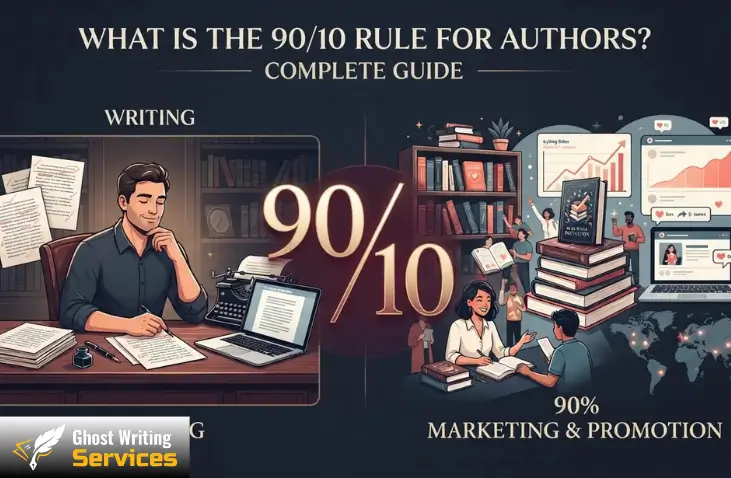
To answer your question, ‘What is the 90/10 rule for book authors?’ The 90/10 rule for authors is built around a simple but uncomfortable idea: roughly 10% of what you do as a writer is responsible for 90% of your actual results. The rest keeps you occupied. It might even feel productive. But it isn’t doing much for your career.
This idea comes from the broader Pareto Principle, which has been observed across industries for over a century. For authors, it shows up in patterns that are hard to ignore once you start looking. One book in your backlist drives most of your sales. One marketing channel brings in most of your readers. One hour of your day, if you protect it fiercely, produces more than the other seven combined.
The question isn’t whether the 90/10 rule applies to you. It almost certainly does. The question is whether you’re organizing your time around it.
A Simple Example for Writers
Here’s a scenario that plays out more often than most authors want to admit, to understand ‘what is the 90/10 rule for authors’. A novelist spends two hours a week writing new chapters. She spends six hours redesigning her website, three hours reading articles about book marketing, and another two hours posting on social media without a clear plan. Fourteen hours have disappeared. The book barely moves.
Now flip it. She has ten focused hours for writing. She spends three hours replying to readers who’ve already connected with her. The manuscript is finished. The audience grows, because there’s finally a book for them to discover.
That’s the 90/10 rule for book authors working in real life. Not a theory. A practical shift in where attention goes.
Author Productivity 90/10 Rule: How Writers Can Focus on High-Impact Work
Most productivity content tells you to squeeze more into your day. Wake up earlier. Use better apps. Build tighter systems. But what is the 90/10 rule for authors saying is a different position entirely. It says you should be doing less, not more, and do it with genuine intention.
For writers, this requires a kind of ongoing honesty. Before you start a task, it’s worth asking: Does this build my leadership, improve my work, or generate real results? If the honest answer is no, you’re looking at something from the 90%. It might feel important. It might be enjoyable. But it is not needed right now.
Why Authors Need The 90/10 Rule
The 90/10 rule helps authors identify the activities that create the greatest impact while reducing time spent on tasks that do not contribute to long-term writing and publishing goals. By focusing on high-value actions, writers can build consistency, improve productivity, and make smarter decisions in a competitive publishing environment.
What Is the 90 10 Rule for Writers’ Importance?
Publishing has never had more open doors than it does right now. Independent authors like speech writers can reach global audiences without a traditional deal. The tools are accessible. The barriers are low. But the same openness that creates opportunity also creates an overwhelming amount of noise. Authors today are expected to be writers, marketers, brand managers, content creators, and business owners all at once. That’s a lot to manage, and it’s very easy to spend your days in motion without making progress.
Common Challenges Authors Face
Time is genuinely limited for most writers. Writing rarely pays the bills at first, which means it competes with jobs, family, and everything else life demands. Every wasted hour stings more than it would if writing were already a full-time arrangement. This is really the moment when one must remember what is the 90/10 rule for authors. For writers managing tight schedules, understanding how ghostwriters service work can also help explore ways to maintain productivity and continue creating content effectively.
Decision fatigue is another real problem. Which publishing platform? Which distributor? Which genre to try next? Which social media channel deserves your energy? When there are too many choices and no clear framework, the default tends to be paralysis or, worse, a new strategy every few weeks.
The author’s 90/10 rule gives you a filter for it all. One question, applied consistently, cuts through a remarkable amount of noise.
The Cost of Focusing on the Wrong Tasks
When authors consistently spend their best hours on low-impact work, the consequences are quiet at first and then compound. Manuscripts take years instead of months. Readers never find books. Marketing happens in panicked bursts right before a launch rather than as a steady, sustainable practice. And the creative energy that should go into the actual writing gets spent on things that won’t matter six months from now.
Author success and the 90/10 rule are connected in a direct way. Protecting high-leverage time isn’t a luxury. It’s the foundation.
How Authors Apply The 90/10 Rule
Understanding the concept is the easy part. Putting it to work in actual daily habits is where it gets harder and more rewarding. Here is how authors use the 90/10 rule across the core areas of their work.
Writing and Manuscript Development
For the vast majority of authors, the single most important activity is putting new words on the page. Not planning to write. Not talking about writing. Actually writing.
The 90/10 rule for book writing productivity starts with treating your writing time as non-negotiable. Schedule it first, before your inbox, before social media, before the dozens of small tasks that will otherwise fill the morning. A daily word count goal works well for most writers. Even 500 words a day is more than 180,000 words a year, which is more than enough for two solid books.
The key is consistency over intensity. Short daily sessions beat occasional marathon sessions almost every time.
Editing and Revision Priorities
Not all editing delivers the same value. A structural pass that fixes your plot’s core problem or tightens the logic of your argument creates far more value than a fifth round of line-level polish. When you’re revising, focus the deepest attention on structure, character, and clarity first. Surface corrections come later. Much of that work can eventually be handed to a professional editor anyway.
90/10 Rule for Publishing Success
For self-published authors, the 90/10 rule for publishing success comes down to making good distribution decisions once, doing them well, and then leaving them alone. A strong book description, the right categories and keywords, a professional cover, and competitive pricing. These elements are set once and keep working for you continuously. Revisiting them weekly without data to guide you is a distraction dressed up as strategy.
Book Marketing and Reader Growth
Marketing can feel like it demands constant activity. The 90/10 rule for authors reveals something counterintuitive here: a very small number of marketing activities produce most of the results. Building an email list, generating genuine reviews, and writing more books are nearly always in the high-value 10%. Posting on every social media platform without a specific strategy almost never is.
The Most Important 10% Of Activities For Authors
Different authors will have slightly different lists depending on where they are in their careers. But across fiction, non-fiction, self-published, and traditionally published writers, these activities show up in the critical 10% again and again. All they need to repeat to themselves is, ‘What is the 90/10 rule for authors?’
Writing Consistently
Nothing replaces regular output. Authors who write consistently, not just in bursts of inspiration, build backlists. They improve their craft with every manuscript. They give readers a reason to keep coming back. Even on difficult days, finding 20 to 30 focused minutes produces something. Over months and years, those minutes add up to finished books.
Building an Email List
An email list is one of the few things in a writer’s marketing toolkit that you actually own. No algorithm buries it. No platform decides who sees it. A list of a few hundred genuinely engaged readers is worth more in practical terms than thousands of passive social media followers. Start building it early, offer real value, and treat it as one of the most important assets in your career.
Author Branding
Readers don’t only buy books. They buy into authors. A consistent, recognizable brand, which includes your genre, your voice, and the visual identity you show up with across platforms, helps readers know what to expect from you. Every piece of content you create works harder when it’s anchored to something coherent. This doesn’t require a marketing team. It requires consistency applied over time.
Reader Engagement
The authors who build lasting careers tend to genuinely connect with their readers. Through newsletters, community groups, personal replies to messages, and simple acknowledgment that real people are on the other end of the relationship. These connections generate word-of-mouth, loyalty, and reviews. None of that is replicable with paid advertising anywhere near the same cost or depth.
Book Reviews and Visibility
Reviews drive discoverability, especially on Amazon and Goodreads. A focused effort to gather honest reviews around your launch window, through advanced review copies, reader communities, or a short story writers service to proofread your work one last time, is one of the beneficial things you can do before a book goes live.
High-Impact Author Activity Checklist
If you are wondering, what is the 90/10 rule for authors? This checklist is for you:
- Write new words every day
- Respond to reader emails and messages
- Collect and share genuine book reviews
- Build and consistently nurture your email list
- Optimize your book listing on retail platforms
- Keep writing your next book
- Spend hours redesigning your website without a clear purpose
- Post on every social platform without a specific plan
- Read every publishing newsletter without acting on the information
The 90/10 Rule For Self-Published Authors
Self-published authors carry a unique weight. They are the writer, the publisher, the marketer, and the small business owner, often simultaneously. Without knowledge of What is the 90/10 rule for authors is, it is genuinely easy to spend every available hour in motion and still feel like you’re falling behind.
Amazon KDP Priorities
On Amazon KDP, the highest-leverage decisions are the ones made during setup. A compelling book description, the right keywords and categories, a professional cover, and a competitive price point. These elements are chosen once and work continuously. Adjusting them without data to guide the changes is an activity that feels productive but rarely is.
Book Launch Optimization
A launch isn’t just a day. It’s a window, usually two to four weeks, where concentrated effort can meaningfully shift your book’s algorithmic position. The highest-impact launch activities are building pre-launch momentum with your email list, coordinating advance review copies, and driving concentrated early sales. The rest is supplementary.
Long-Term Sales Strategies
The most durable long-term strategy for a self-published author is simply to keep writing books. A strong backlist creates a compounding effect that no single marketing campaign can match. New readers discover your first book and immediately move on to books two, three, and four. Author productivity 90/10 rule thinking keeps the focus on output rather than on chasing every new platform or marketing trend.
The 90/10 Rule For Fiction VS Non-Fiction Authors
The 90/10 rule for book authors applies regardless of genre, but the specific activities that fall into the critical 10% look different depending on what you write.
| Activity | Fiction Authors | Non-Fiction Authors |
| Writing priority | New story drafts | Research-backed chapters |
| Marketing focus | Series building, reader communities | Speaking, credibility, media |
| Key platform | Amazon, Goodreads | LinkedIn, newsletters, podcasts |
| Reviews strategy | ARC readers, fan communities | Professional endorsements, testimonials |
| Email list content | Behind-the-scenes, character insights | Actionable tips, industry perspectives |
| Long-term leverage | Backlist and series | Authority positioning |
Fiction Author Priorities
For fiction writers, how authors use the 90/10 rule is largely about protecting creative time and investing in series. Readers of fiction are loyal to characters and worlds. The more books you write in a connected series, the stronger your discovery funnel becomes. Each new book sends new readers back to the first one. Engaging authentically with fan communities also belongs in the top tier. A single enthusiastic reader can generate more organic word-of-mouth than most ad campaigns ever will.
Non-Fiction Author Priorities
Non-fiction authors benefit enormously from positioning themselves as genuine authorities in their field. While knowing what is the 90/10 rule for authors takes you a long way, speaking engagements, podcast appearances, and a well-maintained newsletter build the kind of trust that leads to bulk sales, corporate clients, and a career that outlasts any single book. Writing a second, third, and fourth book deepens authority over time in ways that social media posts rarely can.
How AI Is Changing The 90/10 Rule For Authors (2025-2026)
AI tools are quietly reshaping what the “low-value 90%” looks like for many authors. Tasks that used to take significant time, like drafting query letters, researching comparable titles, or generating early-stage marketing copy, can now be done faster with AI assistance. Questions like “Is AI replacing ghostwriting?” are being asked all across the publishing world, and the honest answer is more nuanced than most headlines suggest.
AI-Assisted Writing
AI writing tools are genuinely useful for brainstorming, outlining, drafting early-stage marketing materials, and working through creative blocks. Used thoughtfully, they move certain tasks out of your high-cost time into a faster lane, which frees you up to spend more hours in the work that actually requires your specific voice and judgment. Professional ghostwriting services can also provide more substantial writing support when your needs go beyond what AI alone can deliver.
AI Editing and Research Tools
Grammar and style tools have existed for years, but newer platforms can offer feedback on structure, consistency, and pacing in ways that were previously only available through paid editors. For non-fiction writers in particular, AI research tools can dramatically compress the time spent gathering and organizing source material.
What Human Authors Should Still Control
Creativity, emotional authenticity, narrative voice, and genuine reader relationships cannot be handed off to any tool. These are exactly the elements that make a book worth reading and an author worth following. The 90/10 rule for authors in the current AI landscape means using tools to clear your path, not to walk it for you. If you want deeper human support for your book project, working with the poetry writing services or memoir writing services is a way to bring your vision to life without sacrificing creative control.
Real Examples Of The 90/10 Rule In Action
Applying the 90/10 rule helps authors shift focus from low-impact activities like excessive social media to high-value work such as writing and completing manuscripts. This balance ensures real progress in publishing while still maintaining a sustainable presence for audience growth.
Beginner Author Example
A first-time novelist spends most of her available writing time on social media. She’s building an audience before the book is finished. It feels like smart preparation. But months pass, and the manuscript barely moves. She applies author success and the 90/10 rule, cuts social posting back to twice a week, and finishes her draft in three months. The book gets published. The audience she was trying to build before could finally find her.
Self-Published Author Example
A self-published thriller writer has three books out, but slow sales. When he looks honestly at his week, he’s spending around ten hours in Facebook groups and about three hours writing. He reverses the ratio and focuses more on creating valuable content. Many authors also explore whether ghostwriters are in demand as a way to increase productivity and maintain consistent publishing schedules. He publishes two more books within twelve months and watches his backlist sales climb as new readers move through his series. The 90/10 rule for publishing success is applied directly.
Non-Fiction Author Example
A business consultant publishes a book to grow her speaking career, but struggles to gain traction. She stops trying to maintain a presence on every platform and focuses on two things only: a bi-weekly newsletter with real, usable insight, and guest appearances on industry podcasts. Within six months, inbound speaking inquiries doubled. The 90/10 rule for book authors helped her trade scattered activity for genuine leverage. If you’re trying to figure out how to get proper support for your book, understanding how to hire a ghostwriter for a book is a useful place to start.
Conclusion
The most asked question, “What is the 90/10 rule for authors?’’ has a very straightforward answer. It’s the recognition that a small number of focused activities produce most of your results as a writer. Everything else fills the hours without much to show for it.
The hard part isn’t grasping the idea. It’s following through when low-value tasks feel urgent. Focus on activities that create real results. Protect time for your writing above everything else. Build reader relationships with genuine care. Use AI and other tools to balance your priorities well, and not to replace creative work that only you are capable of. And revisit your habits regularly, because the right 10% will shift as your career grows and changes.
Whether you’re writing your first book or managing a multi-title catalog, the 90/10 rule for book authors is one of the clearest and most practical lenses available for cutting through distraction and building something that lasts. And if you ever want extra support along the way, the best ghostwriting companies and fiction ghostwriting professionals can help you protect the most valuable resource you have: your creative energy and your time.